'Israel' wages ecocide against southern Lebanon’s woodlands
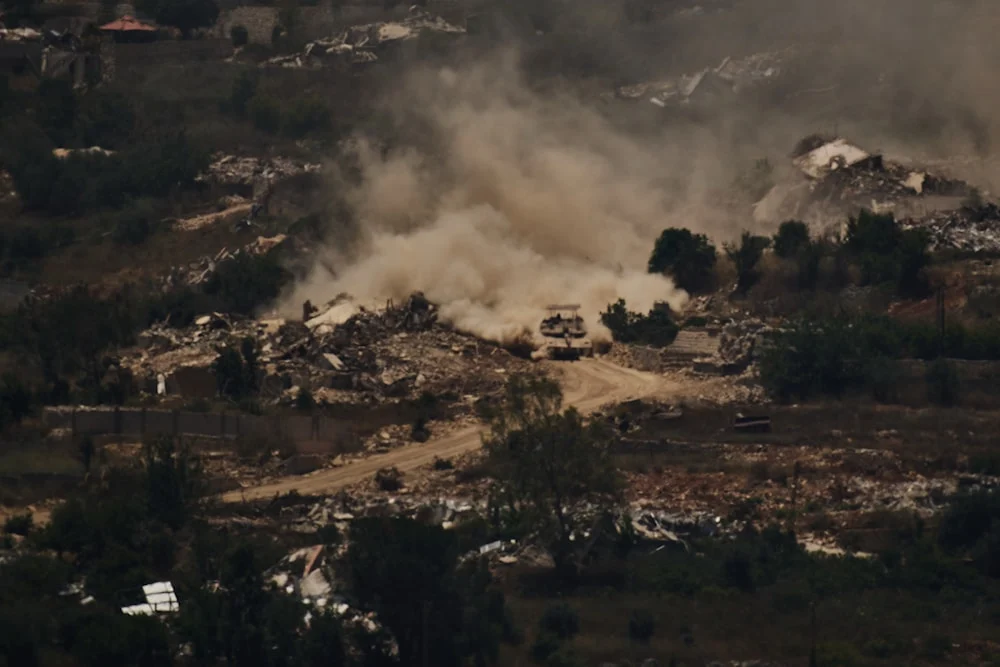
Firefighters and residents in south Lebanon have accused the Israeli occupation forces of deliberately starting wildfires, as forested areas have been consumed by flames following Israeli bombardment.
Environmental organizations said the fires reported in recent weeks reflect a longstanding pattern of Israeli attacks affecting Lebanon’s natural environment.
On Tuesday, the Israeli military dropped flares in a wooded area outside Khiam in south Lebanon, igniting fires. When firefighters moved in to put out the flames, a drone struck nearby, forcing them to retreat, Hussein Fakih, head of civil defense in the Nabatieh region, told the Guardian.
“Most of our missions are now related to fires. There are enormous areas of woodland that have burned; I don’t have the exact figures, but in the areas close to the [frontline], around 30-40% of the land has been affected by fires”, he stressed.
'White phosphorus shells are fired at the woodlands'
According to videos and testimony from first responders, the Israeli occupation forces have caused fires throughout southern Lebanon, particularly in olive groves and agricultural areas, during the nearly two months since the June 17 'ceasefire' that "Israel" is violating daily.
“They started doing this right after the ceasefire, and there have been incendiary bombs every day,” said Fakih. “Small drones come out and drop incendiary materials, [white] phosphorus shells are fired at the woodlands, in addition to illumination flares that they drop during the daytime so the vegetation catches fire".
Similar fires reported in border areas
Firefighters and residents elsewhere in southern Lebanon have also described fires they say were started by Israeli munitions and drones in dry scrubland and wooded areas.
On Friday, Israeli munitions sparked major wildfires in two densely forested locations: Kfarchouba, near the border, and an area between Jezzine and the western Bekaa valley.
Samir Hardan, chief of the local civil defense station, reported that a fire broke out near Kfarchouba on Friday afternoon after a drone dropped a munition into woodland. Firefighters fought the flames through the night and extinguished them on Saturday, but another drone ignited a second fire on Sunday, Hardan added.
Firefighters must coordinate their movements with the Lebanese army, which passes their requests to a “deconfliction” group that includes the Israeli military. They were authorized to tackle fires at only two locations, while being denied permission to reach other areas where flames were spreading.
Environmental groups warn of wider damage
Environmental organizations said the fires form part of a broader pattern of Israeli attacks on Lebanon’s environment, with experts warning that the country’s forests and the biodiversity they sustain are at risk.
“These are long-established woodlands, dominated by productive stone pine alongside oak. They perform critical functions. The wider area is also an important passage and resting ground for migratory birds”, said Hisham Younes, founder of the Lebanese conservation organization Green Southerners.
Younes described the Israeli aggression as an “ecocide”, saying they formed part of a military pattern targeting the environment of southern Lebanon and damaging its ecosystem through munitions, fire and chemicals.
Younes said, "It is not about any single fire or attack, but a pattern of destruction that progressively erodes the ability of ecosystems to function, regenerate and sustain life. When those cascading effects also undermine livelihoods and people’s ability to return to and remain on their land, environmental destruction becomes inseparable from the wider transformation of the territory itself".
Longstanding accusations of environmental destruction
Since the Israeli aggression on Lebanon began on October 8, 2023, "Israel" has repeatedly targeted wooded areas in Lebanon.
Ecologists and rights organizations have warned that fires and other forms of extensive environmental destruction could have broader consequences for civilian populations.
During the summer of 2024, Israeli troops used trebuchets, medieval catapults, to hurl flaming debris over the border wall into Lebanon. The Lebanese army also published photographs of Israeli drones carrying hoses that were used to spray forests with flammable materials.
Health and environmental experts raised concerns in February after Israeli aircraft dropped herbicides linked to cancer on farms in southern Lebanon.
Residents mourn destruction of their land
Beyond the environmental and health effects of the fires, residents of southern Lebanon have grieved the destruction of green spaces in the villages where they grew up.
On Aug. 1, forcibly displaced residents of the border village of Yaroun discovered that their olive and fruit groves, along with their homes, had been burned by Israeli troops occupying the area.
"They had already bulldozed the whole village. Then they set fire to the trees. What remained in this particular area were the olive trees, large groves, with very old olive trees. They started there, then the fire spread along the outskirts of the village", said Hafez Ghasham, mayor of Yaroun.
Residents of Yaroun had already seen the Israeli forces bulldoze all but 20 of the village’s 900 homes in previous months. During their forcible displacement, they pooled money to purchase costly satellite imagery of the village.
“Many of these trees, most of them, in fact, were inherited from our grandparents and parents. They have enormous sentimental value. The trees were also an important source of income for the people of the village,” Ghasham said.
“They are trying to make the land uninhabitable. They are erasing our entire history, our entire culture, all our memories. Maybe the idea is that after some time, it will look as though nobody had ever lived here,” he concluded.